Two measurements decide whether a band fits: the lug width, which is about the watch, and your wrist circumference, which is about you. Most people need the first and only occasionally the second.
Measuring lug width
The lug width is the gap between the two protrusions on the watch case where the band attaches. It is quoted in millimetres and it is the number bands are sold by.
Take the current band off and measure straight across that gap with a ruler. Millimetre precision is not required, because watch bands come in even sizes: you are distinguishing 20 from 22 from 26, not measuring to a decimal.
Measure the gap, not the band. Bands are often cut a fraction narrower than the space they sit in, so measuring the band itself gives the wrong answer roughly half the time. This is the single most common sizing mistake.
No ruler? A standard credit card is 54mm wide. Comparing the gap against a card gets you close enough to tell 20 from 22 in most cases.
When lug width does not apply
Several brands do not use conventional lugs at all, and for those there is nothing to measure. You shop by model name instead.
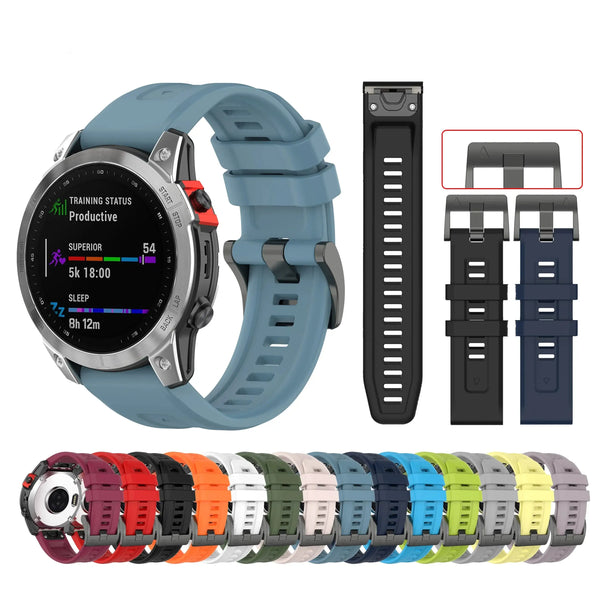
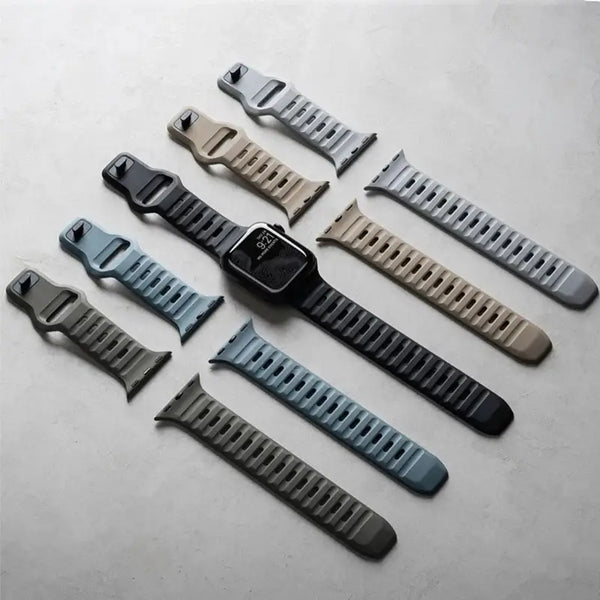
Apple Watch, Fitbit, Google Pixel Watch and Garmin QuickFit all use proprietary fittings. If your watch is one of these, skip the ruler and find the model name, usually printed or engraved on the back of the case.
Measuring your wrist
Most bands fit a wide range of wrists, so you can usually skip this. It matters in three cases: stretch bands with no adjustment, link bracelets that need sizing before wear, and wrists at either extreme of the range.
Wrap a flexible tape measure around your wrist just above the wrist bone, where the watch actually sits. Snug, not tight. Read the measurement where the tape meets.
No tape measure? Wrap a strip of paper or a piece of string around your wrist, mark where it overlaps, then lay it flat against a ruler.
Measure at the end of the day rather than first thing. Wrists swell slightly over the course of a day and in heat, and a band sized to a morning measurement can be uncomfortable by evening.
Common wrist sizes and what they mean
Most adult wrists fall between 140mm and 200mm, and the standard length of most watch bands covers that range comfortably.
Below about 140mm, look for bands sold in a small or short version, and favour slim profiles, since a wide band on a small wrist looks out of proportion as well as fitting poorly.
Above about 200mm, check whether the band comes in a long version. Mesh is the most forgiving option at the top of the range, since it is cut to length rather than hole-punched.
Which band types are most forgiving
Magnetic mesh positions anywhere along its length, so it covers the widest range of wrists and gives an exact fit.
Hook-and-loop nylon adjusts continuously too, and is the cheapest way to get that.
Silicone with closely spaced holes is nearly as good, and better than silicone with widely spaced ones, where the right tension often falls between two holes.
Link bracelets adjust in whole links, which is coarse.
Stretch bands and solo loops have no adjustment at all, which is why wrist measurement matters most for these.
Why fit is not only about comfort
Wrist heart-rate sensors read best when the watch sits snug against the skin about a finger's width above the wrist bone. Too loose and the sensor reads motion rather than pulse; too tight restricts blood flow and skews readings the other way.
Getting the size right at the point of purchase is what makes that adjustment possible at all.
Shop bands for Garmin, Apple Watch, Samsung Galaxy and more.